Writers have always banded together. Byron, Shelley (his wife Mary), and Keats is one of the first to come to mind for me. And of course, the whole band of Pre-Raphaelites (Rossetti, Morris, Burnes-Jones, Hunt, and Millais, etc.) whose artwork, poetry and writing spanned decades, with many different styles, subjects, and scandals.
There's a reason writers do this: it's called like-mindedness, and it's a practice that continues to great extent today. They're even portrayed in shows like Castle, where mystery writers Michael Connelly, James Patterson, Dennis Lehane and, until his death, Stephen Cannell get together to for their poker nights and brainstorming sessions. One big difference, though, is that thanks to the joy that is the interwebs, we're no longer limited to keeping groups within easy travel distance.
I'm lucky enough to have my own wonderful group of writers scattered across the globe. It's full of people who understand me and what I'm talking about, offering endless support and encouragement, and a shoulder to cry on when the big Rs come in.
The other day I was stuck on a scene. I posted: "I have to kill two people on an empty residential street in the middle of the day. Help!" - and the response was not "Why?", or "how horrible!", it was simply, "How."
Another exchange went along the lines of: "I burned 4 people alive today." The response: "Now that's cool."
These reactions are not what you would generally hear from people who live solely in the real world and are missing that essential writer insanity.
While I appreciate all of my the support I get from my family and friends, it's fantastic to have a group I can relax around, and say things like "wip" and "beta", and obsess about word count without being regarded as a lunatic. They understand the importance of self-induced goals, and will be there to encourage that extra cookie, or the third rye and ginger - anything that will help you get it done.
If writing is an addiction, writers groups are also the greatest enablers. When a deadline looms, non-writers would try to remind you that there's a life away from the computer, and that it's okay to get out for some fresh air, see your friends, eat; writer friends are there to tie you down to your chair and force-feed you caffeine pills until that draft is finished.
I don't know where I'd be without these guys (probably much healthier in body, but much less so in mind), so I would like to take a moment to introduce them. Check them out and be sure thank them for helping me become the slightly neurotic person I am today.
Colin Barnes, Anne Michaud, Angela Addams, Tammy Crosby, T James, Sean Hayden, Keri Lake, Jen Wylie, Aaron Booth, Pat Hollet, Ren Warom, Amy Overley and of course all the people at Devin's forum.
Thursday, December 15, 2011

Monday, December 12, 2011
Research
Bad facts in literature bother me. I'm not about to claim that I'm an ultimate source of correct information - or even that I don't get things wrong a lot - but when I read about something I know well and find the info goes against everything I've read, I get very irritated. Best example (as my friends will attest to) is in The Other Boleyn Girl, where Anne is cast as the older sister. Never ceases to make me want to throw the book against the wall.
One of the perks of pure fantasy is that the need for research can be minimal. You want frying pans that can cook an egg on any surface? Pfft - you don't need science (logic, what's that?), just use magic! Anything goes, as long as it stays consistent (a subject on which I have written many an article here).
My current project isn't as forgiving, and it's a bit of a challenge. Falling solidly in the category of urban fantasy, my Daughter of Time series takes place in multiple cities across the present day world, as well as in pivotal events in history. I spend hours these days on Google Maps and official city web pages, picking spots for things to happen, and then doing a breakdown of how long it would take my characters to run in a mad chase from the cafe on the corner (which I choose very specifically), to the ravine that's usually a favourite tourist spot, but at this moment is conveniently quiet. My biggest concern for the present is that readers from one of the cities I choose will get to that chapter and go "Pfft, well of course they get in trouble. I wouldn't go into that area if I had my own personal militia." At least I'll know I've done the best I can.
In the past I get bogged down with other details in my crazy attempt to avoid anachronisms. I research the food they'd eat, the clothes, the styles of the inn, the family structure, to the point where I despair of ever getting it right and offending the ghosts of centuries ago by making the peasants eat ham, when the poor never would have eaten ham because it was too expensive (but I could be getting that confused. Again).
Eventually, mid-way through a chapter, I will give up this frantic desire to be right, and stick with "close enough". The truth of the matter is that, while wanting it to be realistic, the ingredients in the evening stew do not have a bearing on the plot. I write fantasy, and while history plays a major element in my story, I do not write historical fiction.
When research starts to take away the pleasure of the writing, it's time to rethink what you really should be researching, or why you chose to use the subject in the first place. Sometimes its just a case of getting hung up on the details, and losing focus on the important part of writing: the story.
Google Maps I will continue to play with. But just because it's fun.
One of the perks of pure fantasy is that the need for research can be minimal. You want frying pans that can cook an egg on any surface? Pfft - you don't need science (logic, what's that?), just use magic! Anything goes, as long as it stays consistent (a subject on which I have written many an article here).
My current project isn't as forgiving, and it's a bit of a challenge. Falling solidly in the category of urban fantasy, my Daughter of Time series takes place in multiple cities across the present day world, as well as in pivotal events in history. I spend hours these days on Google Maps and official city web pages, picking spots for things to happen, and then doing a breakdown of how long it would take my characters to run in a mad chase from the cafe on the corner (which I choose very specifically), to the ravine that's usually a favourite tourist spot, but at this moment is conveniently quiet. My biggest concern for the present is that readers from one of the cities I choose will get to that chapter and go "Pfft, well of course they get in trouble. I wouldn't go into that area if I had my own personal militia." At least I'll know I've done the best I can.
In the past I get bogged down with other details in my crazy attempt to avoid anachronisms. I research the food they'd eat, the clothes, the styles of the inn, the family structure, to the point where I despair of ever getting it right and offending the ghosts of centuries ago by making the peasants eat ham, when the poor never would have eaten ham because it was too expensive (but I could be getting that confused. Again).
Eventually, mid-way through a chapter, I will give up this frantic desire to be right, and stick with "close enough". The truth of the matter is that, while wanting it to be realistic, the ingredients in the evening stew do not have a bearing on the plot. I write fantasy, and while history plays a major element in my story, I do not write historical fiction.
When research starts to take away the pleasure of the writing, it's time to rethink what you really should be researching, or why you chose to use the subject in the first place. Sometimes its just a case of getting hung up on the details, and losing focus on the important part of writing: the story.
Google Maps I will continue to play with. But just because it's fun.
Thursday, December 8, 2011
Jocelyn A. Fox's The Iron Sword - A review
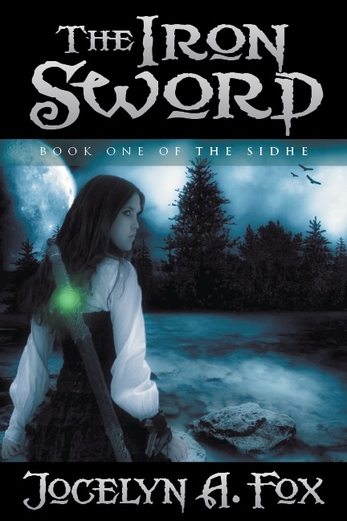
Molly has been summoned to the Unseelie Court of the Sidhe and before she knows it, Tess is drawn into the mystical and dangerous world of the Fae. For there is darkness rising beyond the veil, and even though Tess knows she is no match for the evil stalking the Sidhe, she has no intention of leaving her best friend to face it alone...
Writing good fantasy is challenging - especially when it involves fairies. Let's face it, the world is so overwhelmed with zombies lately that little people who flutter around and glow just aren't getting the attention they once did when Peter Pan was new and Tinkerbell was a sex symbol (...really?).
Fox's The Iron Sword reminds me why the fae once had such an important place in fantasy literature.
I'm finding it hard to narrow down what I best liked about the novel for this review. Whenever I settle on one aspect, I realise there's another one I like more, and then another. What I'll start with is that I couldn't put the book down. Self-set curfews lost their meaning, morning bus schedules disappeared from my head - I just had to know what was coming next. And the worst part (best part) is that the chapters are shorter, all of them ending on a suspenseful note - so when I did manage to put it down to go to work, I was plagued for the rest of the day with the desire to know what happened.
Faeortalam, the fae world Fox has created, is also magnificent. It is a true utopia, crafted partly with ideas from our own world, partly with the fantastic and marvellous, with a very dark underlying structure, Faeortalam is a great place to lose yourself for an hour or ten. These Sidhe are not sweetness and rainbows and magic dust - they're stuck with the same flaws, conflicts of character, and dark sides as any human. And it's about to cause a lot of trouble in their world.
While there is a wide array of characters - even the weapons having minds of their own - my favourite are the Glasidhe or the Small Folk. These guys are more like the Tinkerbells of this world. They're small, they glow, they flit around and deliver messages, and can kill things 5x their size. You know those times when you're reading a book and think, "Man, I wish that was real? I want one as a friend"? Yeah, that's the Glasidhe for me.
The Iron Sword has been described as "epic adventure" genre, and I would have to support that claim. It's fast-paced, fun, quest-driven, fun, beautifully written and fun. The first in a series, all I can say is that I wish Fox would take the time off work she needed to finish the next one. Please?
Monday, December 5, 2011
Characters on Strike?!
I was brainstorming the current section of my work in progress the other day when a horrifying thought occurred to me - what if all the characters currently being written went on strike? I don't mean writer's block, I mean the utter refusal of your characters to do what you ask them to.
Think about it. It's not impossible.
Look at what we put these people though. We hurt them, kill them, kill the people they love, torture them in incredibly imaginative ways, give them blissful happiness only to strip it all away in one great traumatic moment that leaves them nothing but a shriveled husk on the inside that we then expect them to find a way out of - why on earth do they put up with it? What if one day they didn't?
What if one morning, you go to open for your manuscript and instead of sending your hero into battle, or your heroine into the dragon's cave they're siting around in a nice warm conflict-free inn reading a book and drinking tea? You tell them: "All right, suit up. It's time to get going." And they look at you, shrug and say, "You do it. I'm busy."
Novels wouldn't get finished! They would all stop abruptly in an anticlimactic, safe and drama-less disaster where the plot is never resolved, no lessons are learned, no villain slain...and there would be nothing you could do about it.
It's dangerous to take characters for granted. They put a lot of trust in us that no matter how much pain we bring to them, they will always get a satisfying ending, whether it's a glorious or brilliantly gruesome death, or love, a family, and a peaceful rest-of-life. They cooperate with us because they know as well as we do that they are needed. That they have a role in protecting the world, or someone they care about.
This morning I present a toast of my morning tea to thank the many, many, many people wandering around in my head for always being there when I need them, and for taking me on great journeys I had never outlined or anticipated, and for warning me when I'm about to do something stupid. Cheers! (and don't leave me)
Think about it. It's not impossible.
Look at what we put these people though. We hurt them, kill them, kill the people they love, torture them in incredibly imaginative ways, give them blissful happiness only to strip it all away in one great traumatic moment that leaves them nothing but a shriveled husk on the inside that we then expect them to find a way out of - why on earth do they put up with it? What if one day they didn't?
What if one morning, you go to open for your manuscript and instead of sending your hero into battle, or your heroine into the dragon's cave they're siting around in a nice warm conflict-free inn reading a book and drinking tea? You tell them: "All right, suit up. It's time to get going." And they look at you, shrug and say, "You do it. I'm busy."
Novels wouldn't get finished! They would all stop abruptly in an anticlimactic, safe and drama-less disaster where the plot is never resolved, no lessons are learned, no villain slain...and there would be nothing you could do about it.
It's dangerous to take characters for granted. They put a lot of trust in us that no matter how much pain we bring to them, they will always get a satisfying ending, whether it's a glorious or brilliantly gruesome death, or love, a family, and a peaceful rest-of-life. They cooperate with us because they know as well as we do that they are needed. That they have a role in protecting the world, or someone they care about.
This morning I present a toast of my morning tea to thank the many, many, many people wandering around in my head for always being there when I need them, and for taking me on great journeys I had never outlined or anticipated, and for warning me when I'm about to do something stupid. Cheers! (and don't leave me)
Thursday, December 1, 2011
Flash Fiction - November
November flash is finished, and I came in second place - thanks to all who voted! For those of you who didn't get a chance to read it: voila! I'd love to hear your thoughts.
I’ve been called the Angel of Death,
but I am no angel – just Lucy, a failed science experiment. Since the day I was
released I have clung to the night for its protection, it’s warmth. To avoid
the looks of people who can’t understand. The night has taken care of me and
I’ve sworn to return the favour.
Tonight I sit upon the highest
building in the city, watching the odd red and white car lights flicker like
gems through the web of streets. The weather is warm, the stars in full force,
a mirror of the streetlights below. The moon is full; my strange shadow keeps
me company.
A sharp scream echoes from one of
the alleyways twenty stories below and I sigh. Lovely weather always brings the
loonies out to play. Scanning the dark side-street with sharp eyes, I see
movement and focus my aim. Then I jump.
As I fall, two great black wings
stretch out from between my shoulder blades, a fourteen-foot wingspan of inky
feathers that look like satin in the moonlight. The effect of human-animal
genome splicing, these wings are my burden and my blessing. I accept what I am.
I blink jet black eyes to refocus on
my target. I see him now, running towards the busy main road, a woman’s purse
tight in his hands. I have to catch him before he hits the street or he’ll be
lost to the real world, away from the shadows that hide me. I beat my wings,
twice, three times, the gust of each flap scattering waves of dust beneath me.
He’s directly in front of me, almost at his goal.
I let out a shriek and extend
talon-sharp nails. He looks over his shoulder but has no time to scream, to
react. I drop lower and tear into his neck. The purse falls from his hands and
his body slumps.
Without a glance backwards, I beat
my wings once more to return to my perch.
The night belongs to me.
I do what I can to protect it.
Subscribe to:
Posts (Atom)